

Take Two: ECB holds rates; oil price surpasses $100
What do you need to know?
The European Central Bank left its benchmark interest rate on hold at 2.25%, as expected, citing that uncertainty remains high. The central bank, which lifted rates by a quarter point in June, also noted that while eurozone inflation declined last month to 2.8%, from May’s 3.2%, the effects of the Middle East conflict are likely to keep inflation above the 2% target into the first half of 2027. While the decision to keep rates steady was unanimous, ECB President, Christine Lagarde said “there were some governors who asked themselves whether we should not consider a hike”.
Around the world
The oil price surpassed the $100-a-barrel mark, for the first time since May on Thursday, following further hostilities in the Middle East. Oil prices have been rising in the wake of the breakdown of the ceasefire between the US and Iran, and the global benchmark, Brent crude, broke through the threshold after attacks in the Red Sea. Lower oil prices had provided some respite during June, which saw inflation drop in several major markets. In addition, late last week, the US government renewed its trade war as it introduced a new wave of tariffs on dozens of nations.
Figure in focus: 60 trillion yuan
China aims to increase retail sales to around 60 trillion yuan (around US$8.8 trillion) by 2030, as part of a five-year plan to boost domestic consumption. This would represent an almost 20% increase on 2025’s figure, according to reports. China has suffered from weak domestic demand, which contributed to its slowest quarterly pace of economic growth since 2022 in the second quarter of this year, recent data showed. This is the first time Beijing has launched a five-year plan specifically prioritising consumption, while also aiming to boost employment and raise household income to support the domestic economy.
Chart of the week
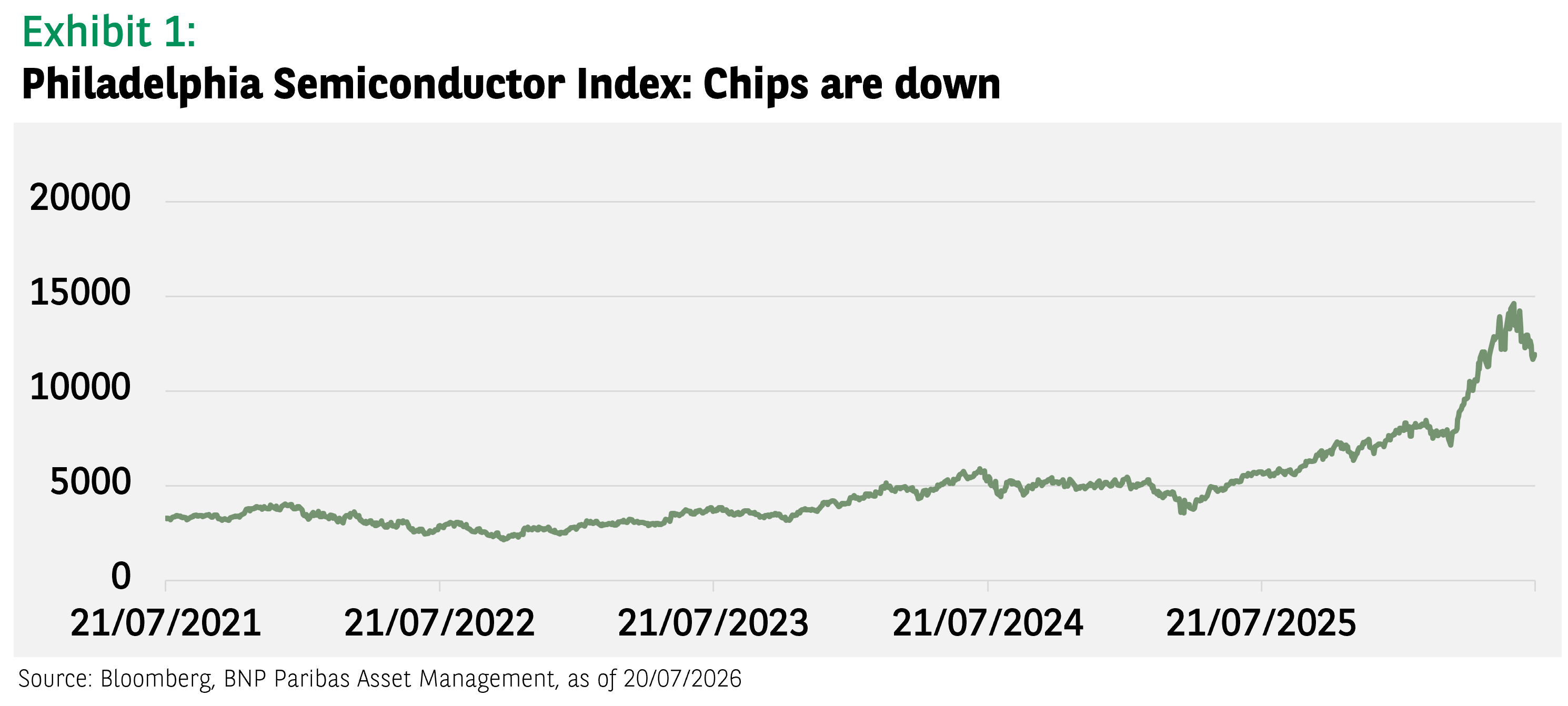
An 80% plus rise in the first six months of 2026 put the Philadelphia Semiconductor Index (SOX), which tracks the biggest US-listed chip manufacturers, on track for its largest annual return since 1999. But over the past month, it has fallen by around 20%. Prices for the chips that underpin artificial intelligence have surged this year as suppliers struggle to match soaring demand from large technology companies. The rapid rise reflects the continuing demand for AI and its necessary components, though the recent sell-off showed how some investors are questioning how long the demand boom can continue.
Words of wisdom: ESPR
Large European companies are no longer allowed to destroy unsold clothes, accessories or footwear, as part of new measures to support the transition to a circular economy. Part of the Ecodesign for Sustainable Products Regulation (ESPR), which was introduced in 2024, the new rule came into force this month. It means large companies must now prioritise selling, donating or repairing items, with medium-sized companies subject to the same ban from 2030. Currently, 4%-to-9% of all textile products on the market in Europe are destroyed before use, the European Commission said.
What’s coming up?
Monetary policy is in focus this week. On Wednesday, the Federal Reserve convenes to set interest rates, while the Bank of England meets on Thursday, followed by the Bank of Japan on Friday. In terms of economic data, the Eurozone and US issue their respective preliminary estimates for second quarter GDP growth on Thursday. On Friday, the eurozone publishes flash inflation data for July.
Read more insights at the Investment Institute



Disclaimer
BNP Paribas Group's acquisition of AXA Investment Managers was completed on 1 July 2025, and AXA Investment Managers is now part of BNP Paribas Group.
This website is published by AXA Investment Managers Australia Ltd (ABN 47 107 346 841 AFSL 273320) (“AXA IM Australia”) and is intended only for professional investors, sophisticated investors and wholesale clients as defined in the Corporations Act 2001 (Cth).
This publication is for informational purposes only and does not constitute investment research or financial analysis relating to transactions in financial instruments, nor does it constitute on the part of BNP Paribas Asset Management or its affiliated companies an offer to buy or sell any investments, products or services, and should not be considered as solicitation or investment, legal or tax advice, a recommendation for an investment strategy or a personalized recommendation to buy or sell securities.
Market commentary on the website has been prepared for general informational purposes by the authors, who are part of AXA Investment Managers. This market commentary reflects the views of the authors, and statements in it may differ from the views of others in BNP Paribas Asset Management.
Due to its simplification, this publication is partial and opinions, estimates and forecasts herein are subjective and subject to change without notice. There is no guarantee forecasts made will come to pass. Data, figures, declarations, analysis, predictions and other information in this publication is provided based on our state of knowledge at the time of creation of this publication. Whilst every care is taken, no representation or warranty (including liability towards third parties), express or implied, is made as to the accuracy, reliability or completeness of the information contained herein. Reliance upon information in this material is at the sole discretion of the recipient. This material does not contain sufficient information to support an investment decision.
All investment involves risk , including the loss of capital. The value of investments and the income from them can fluctuate and investors may not get back the amount originally invested.