

Take Two: UN reduces its global growth forecast; eurozone inflation rises
What do you need to know?
The United Nations has lowered its global economic growth forecast and raised its inflation expectations because of the ongoing Middle East conflict. It now anticipates global GDP will grow 2.5% this year, below January’s 2.7% forecast, before recovering modestly to 2.8% in 2027. In addition, the UN expects global inflation will reach 3.9% in 2026, some 0.8 percentage points above its January forecast. It highlighted that artificial intelligence-related investment, resilient consumer demand and a solid labour market in some economies could provide some support. However, the impact of the crisis is anticipated to be uneven, with western Asia expected to see the biggest hit to growth.
Around the world
Eurozone annual inflation rose to 3% in April, its highest level since September 2023 and up from 2.6% in March, due to rising energy prices related to Middle East supply constraints. Core inflation - excluding more volatile energy, food, alcohol and tobacco prices - eased to 2.2% from 2.3% in March. Meanwhile US Federal Reserve policymakers noted that interest rates may need to rise if inflation remains persistently high, the minutes of their latest meeting showed. Elsewhere, Japan’s economy grew 2.1% on an annualised basis in the first quarter, beating Q4’s 1.3% growth, while inflation fell to 1.4% in April from 1.5% in March.
Figure in focus: 30%
Nearly 30% of all cars sold worldwide this year are expected to be electric vehicles, up from around 25% in 2025, according to the International Energy Agency. It said global electric car sales are expected to reach 23 million in 2026, up from 20 million the year before, with Chinese automakers supplying 60% of the electric cars sold worldwide. Worries over high fuel prices, as well as falling battery prices, are expected to provide further momentum, the IEA said. By 2035, the global EV fleet – excluding two and three-wheelers – is projected to reach 510 million vehicles, up from nearly 80 million today.
Chart of the week
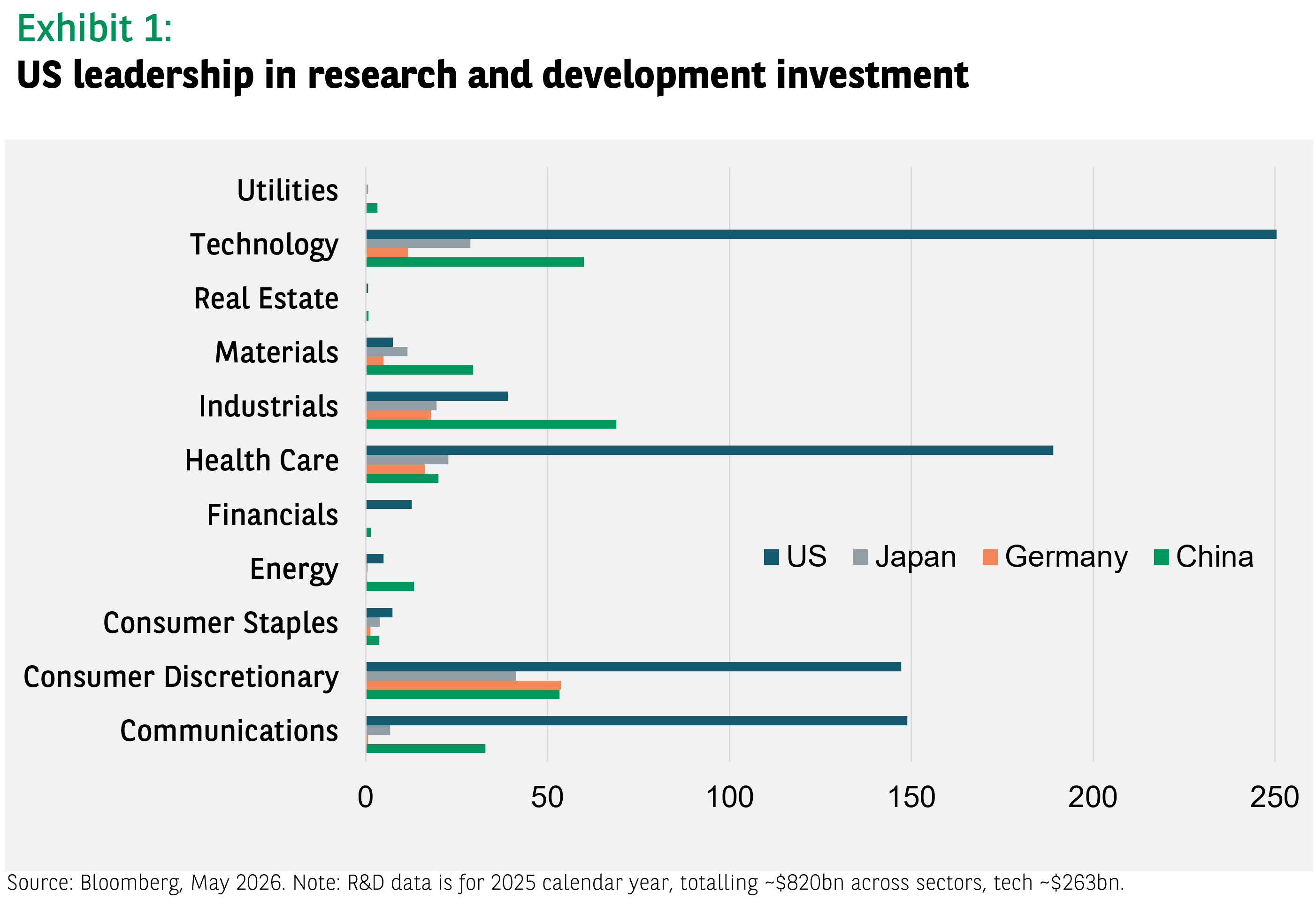
The US dominates research and development investment across most sectors, particularly technology. This reflects its innovation-driven economy, bolstered by vibrant venture capital markets, world-renowned university research, and leading technology and pharmaceutical firms. The significant gap between US R&D expenditure and that of other major economies – such as China, Japan, and Germany – helps US companies stay at the forefront of technological advancements and contribute to economic growth. Notably, some of the largest US tech firms, such as Amazon, Alphabet, Microsoft, Oracle, Meta, and CoreWeave, are projected to allocate nearly $800 billion to capital expenditure in 2026, primarily to expand generative AI infrastructure – a figure that could reach $1.1 trillion in 2027, based on those companies’ projections.
Words of wisdom
Carbon pricing: Carbon pricing aims to curb greenhouse gas emissions by placing a fee on generating emissions and/or offering incentives for cutting them. This approach can motivate companies to adopt greener practices as it internalises the costs of pollution, shifting the cost of climate change damage from the public to the emission producers. Carbon pricing can take multiple forms, including emission trading systems and carbon taxes. According to a report from the World Bank Group, carbon pricing now covers nearly 30% of global greenhouse emissions and mobilised more than $107 billion for public budgets in 2025.
What’s coming up?
Wednesday sees Australia issue inflation data. On Thursday the Eurozone publishes its latest economic and industrial sentiment measures, and the US reports a second estimate for Q1 GDP growth – the previous estimate showed the world’s largest economy had expanded by 2% on an annual basis over the period. On Friday, Japan publishes its latest unemployment data along with industrial production figures, and Canada issues Q1 GDP growth figures.
Read more insights at the Investment Institute


Disclaimer
BNP Paribas Group's acquisition of AXA Investment Managers was completed on 1 July 2025, and AXA Investment Managers is now part of BNP Paribas Group.
This website is published by AXA Investment Managers Australia Ltd (ABN 47 107 346 841 AFSL 273320) (“AXA IM Australia”) and is intended only for professional investors, sophisticated investors and wholesale clients as defined in the Corporations Act 2001 (Cth).
This publication is for informational purposes only and does not constitute investment research or financial analysis relating to transactions in financial instruments, nor does it constitute on the part of BNP Paribas Asset Management or its affiliated companies an offer to buy or sell any investments, products or services, and should not be considered as solicitation or investment, legal or tax advice, a recommendation for an investment strategy or a personalized recommendation to buy or sell securities.
Market commentary on the website has been prepared for general informational purposes by the authors, who are part of AXA Investment Managers. This market commentary reflects the views of the authors, and statements in it may differ from the views of others in BNP Paribas Asset Management.
Due to its simplification, this publication is partial and opinions, estimates and forecasts herein are subjective and subject to change without notice. There is no guarantee forecasts made will come to pass. Data, figures, declarations, analysis, predictions and other information in this publication is provided based on our state of knowledge at the time of creation of this publication. Whilst every care is taken, no representation or warranty (including liability towards third parties), express or implied, is made as to the accuracy, reliability or completeness of the information contained herein. Reliance upon information in this material is at the sole discretion of the recipient. This material does not contain sufficient information to support an investment decision.
All investment involves risk , including the loss of capital. The value of investments and the income from them can fluctuate and investors may not get back the amount originally invested.