

In medias res
With updates on the Middle East conflict coming minute by minute, one can only observe the market’s reaction to the latest developments, attempt to divine the implicit assumptions, and imagine scenarios for how the situation might evolve.
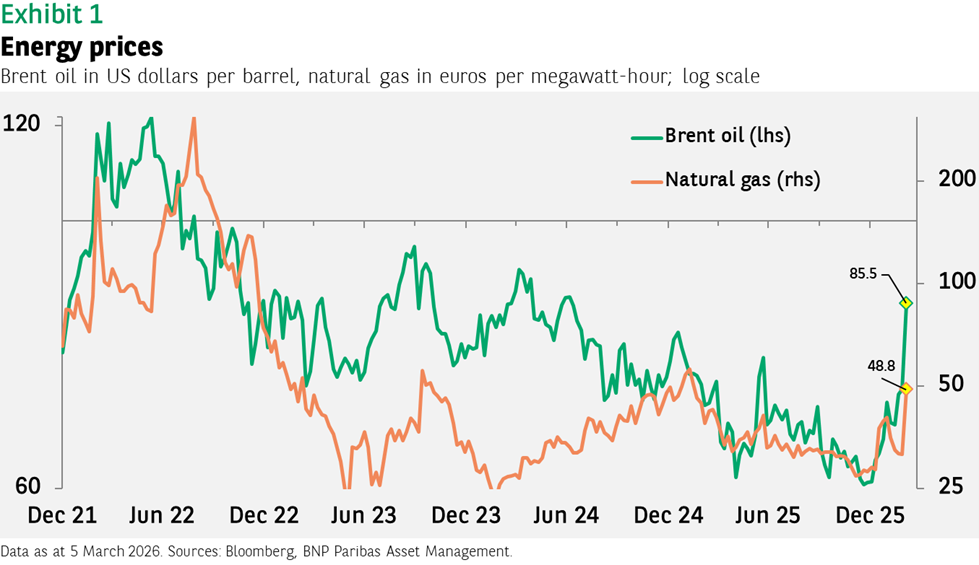
The single most important market price in our view is that of Brent crude oil. At the time of writing, Brent oil was trading at $86 per barrel, a 20% increase from the previous Friday’s close (see Exhibit 1). While a meaningful increase, it is less than the worst predictions of $100-plus and below previous peaks of the last few years. Market expectations point to a decline in the weeks ahead. The implicit market view of the progress of the war, then, seems to be that it will continue for weeks, not months, and the conflict’s intensity will decrease over time. The reported drop in the number of missiles and drones launched by Iran over the last few days supports this view. A total block of traffic through the Strait of Hormuz should be avoided (Iran also needs to be able to export its own oil, so it is not in the country’s interests to close the passageway). These assumptions could clearly change at any moment if, for example, a critical energy node is struck.
Other asset classes have generally performed as one would expect (this is not the first crisis in the Middle East), though there is still variation compared to previous episodes. Oil prices have gained more than they did during the Gulf War, and the US dollar has strengthened more than it did during the other crises, belying somewhat the “sell America” mantra (see Exhibit 2).
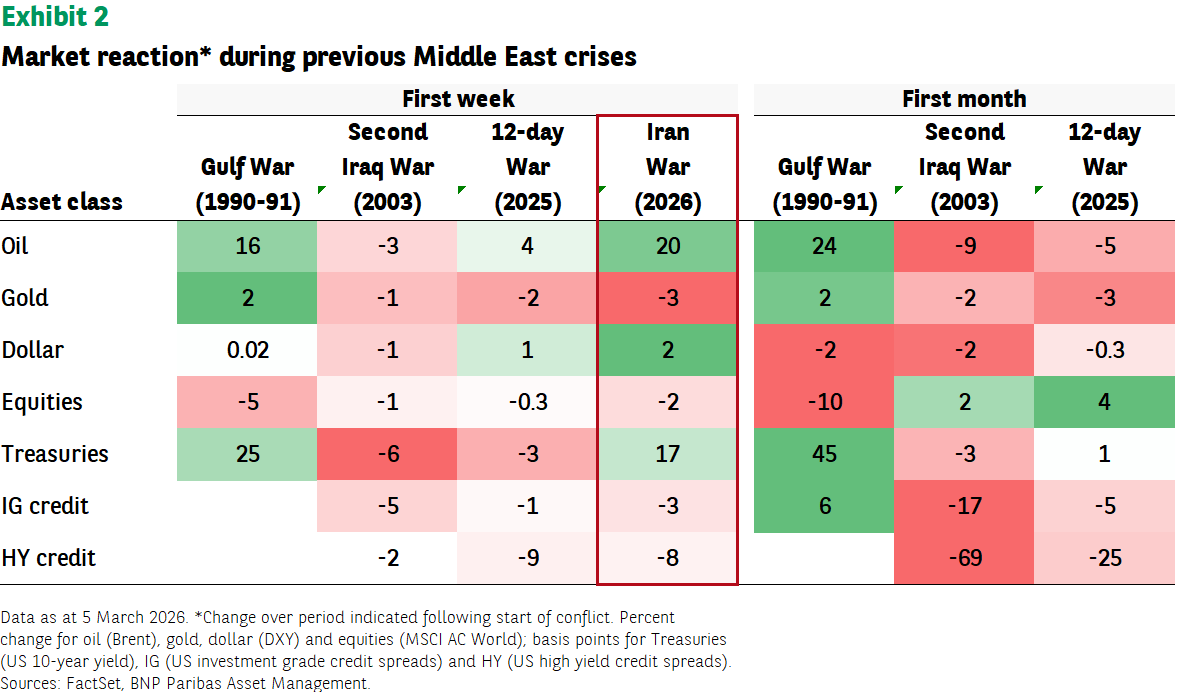
US Treasury yields have risen over the last week as inflation worries offset the asset’s perceived ‘safe haven’ appeal. The decline in equities has been moderate, but this obscures a wide range of returns across different industries: precious metals have dropped 16% and airlines 9% while oil stocks are up 4%-5%.
The crisis has triggered a reversal of some previously successful (or unsuccessful) trades as extreme long or short positions get washed out. For example, the MSCI Korea index, which had surged 58% in local currency terms year to date, has fallen 12% since Friday 27 February. Japanese equities have suffered similarly. US software stocks, by contrast, have rebounded after their notable underperformance of the last several months, gaining 4% over the week.
As with any crisis, asset prices change, which may lead to opportunities (at the appropriate time) to establish positions at more attractive valuations. Despite the turmoil provoked by the war, it has not (yet) changed our fundamentally constructive outlook for risks assets this year. For that to happen, we would need to see oil prices rise much more and then stay at an elevated level for an extended period of time.
And elsewhere …
While the war understandably dominates headlines and investors’ attention, economic data continues to be released, providing us with an ongoing assessment of the health of the global economy. The caveat is that these figures do not reflect the current situation, but they nonetheless give us a picture of how weak or strong economies are in the face of the new challenges.
The picture over the last week has been encouraging. The expansion in business activity, as measured by Purchasing Managers’ Indices, looks to be continuing in the services sector. The US stands out as the February ISM Services index jumped to 56.1, the highest level in four years (a reading above 50 indicates expansion). For the manufacturing sector, the figures are more modest, mostly just above 50, but those for the largest European countries are all above 50 for the first time in many years.
The surprisingly weak US non-farm payrolls figure, alongside negative revisions to the prior month, will assuage worries about an overheating economy. This may offset some of the inflation worries stemming from the rise in oil prices and bolster support for cuts from the US Federal Reserve this year.



Disclaimer
BNP Paribas Group's acquisition of AXA Investment Managers was completed on 1 July 2025, and AXA Investment Managers is now part of BNP Paribas Group.
This website is published by AXA Investment Managers Australia Ltd (ABN 47 107 346 841 AFSL 273320) (“AXA IM Australia”) and is intended only for professional investors, sophisticated investors and wholesale clients as defined in the Corporations Act 2001 (Cth).
This publication is for informational purposes only and does not constitute investment research or financial analysis relating to transactions in financial instruments, nor does it constitute on the part of BNP Paribas Asset Management or its affiliated companies an offer to buy or sell any investments, products or services, and should not be considered as solicitation or investment, legal or tax advice, a recommendation for an investment strategy or a personalized recommendation to buy or sell securities.
Market commentary on the website has been prepared for general informational purposes by the authors, who are part of AXA Investment Managers. This market commentary reflects the views of the authors, and statements in it may differ from the views of others in BNP Paribas Asset Management.
Due to its simplification, this publication is partial and opinions, estimates and forecasts herein are subjective and subject to change without notice. There is no guarantee forecasts made will come to pass. Data, figures, declarations, analysis, predictions and other information in this publication is provided based on our state of knowledge at the time of creation of this publication. Whilst every care is taken, no representation or warranty (including liability towards third parties), express or implied, is made as to the accuracy, reliability or completeness of the information contained herein. Reliance upon information in this material is at the sole discretion of the recipient. This material does not contain sufficient information to support an investment decision.
All investment involves risk , including the loss of capital. The value of investments and the income from them can fluctuate and investors may not get back the amount originally invested.