

Why Choose Euro Fixed Income?
KEY POINTS
Euro fixed income became the byword in 2025 for investors looking to diversify away from US policy-driven uncertainty. With tariff concerns diminished and a potentially uncontentious Federal Reserve chair appointment on the horizon in the US, while in Europe a heavy debt supply has been boosted by fiscal slippage, can euro fixed income still attract investors?
We believe there are five strong reasons for still considering euro fixed income as part of an investor’s fixed income allocation:
1. The asset class offers a granular exposure to multiple performance drivers
Euro fixed income offers a wide range of performance engines which, if well utilised, can enable portfolios to effectively navigate market cycles. Indeed, the universe offers exposure to a multitude of sovereign debts as well as quasi-sovereigns, investment grade and high yield debt. Hence when looking at 2025, despite sovereign debts overall not providing a strong return contribution, on a case-by-case basis, some countries delivered far better returns than others. Peripheral sovereign debt, for example, on the back of better fiscal discipline and better growth prospects outperformed core sovereigns by close to 3%.
The same goes for euro investment grade (IG) credit, which thanks to sound margins in a resilient economy delivered more than 3% returns. Digging into euro IG credit sector, the subordinated segment even delivered more than 5% returns. This diversification of engines, influenced by different driving forces, highlight how active management can significantly influence returns and continue to offer opportunities going into 2026.
2. Yields are close to historical highs
While intuitively, many may turn to the high yield sector to enhance income, with credit spreads tight, investors are not necessarily being paid for the additional risk of going down the credit quality spectrum. This is where the high quality and diverse nature of euro fixed income can come into its own. At close to 3%, the 10-year Bund yield is back to 2011 levels and well above its 1.8% average over the past 20 years. Meanwhile, money market rates have declined as the ECB cut rates to 2%. At the same time, 10-year Treasury yields are now far off their 5% highs, back to the 4.20% range, which once hedged back to Euro gives you 2.50%.
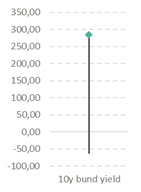
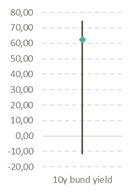
10-Year Bund Yield Range:
Over the past 5 years adjusted for volatility (bps)
Over the past 5 years (bps)
Source: BNPPAM, Bloomberg as of 31 January 2026
Some might argue that volatility has increased as rates picked up in recent years. This is true. Rates volatility has doubled over the past few years compared to the pre-2022 QE era. Yet, in 2025 the opposite happened. Rates continued to go up, but wasn’t accompanied by a further pick up in volatility. This is important because it means that not only are 10-year bund yields at historical high, but they remain so even when adjusted for volatility.
We believe that this makes euro bonds look particularly good both in absolute and relative terms and offers a compelling investment opportunity.
3. Fundamentals look good for the euro area
If rates are this attractive in the euro area, it’s not a surprise: The rebound in inflation and, more recently, fiscal slippage have taken us where we are.
Yet, inflation in the euro area is now at the ECB’s target and might even undershoot during 2026. Even when considering the German fiscal plan, the euro area’s deficit is expected to stay slightly above 3%. This is a different picture from the US where inflation is still well above target and the deficit might head towards 6%. In the meantime, the economy is expected to progressively benefit from additional fiscal spending, supporting the area’s growth prospects and corporate fundamentals. Hence, with inflation under control, better growth prospects, more fiscal leeway, and a central bank at neutral rate, euro fixed income seems to be in a good place.
4. The asset class serves a strong role of drawdown mitigation
Fixed Income generally serves a defensive purpose in a global allocation combined with equity. During risk averse periods when equity prices drop, bonds should act as a buffer thanks to declining yields. Allocating to fixed income is generally not about targeting to enhance returns but rather about managing the portfolio’s risk profile. Indeed, historical data shows that mixing fixed Income and equity together reduces maximum drawdowns without affecting the Sharpe ratio. At a time of high uncertainty after years of strong equity returns, this might be a good moment to think about drawdown mitigation. In this context, euro fixed income, which exhibits the lowest correlation to equity compared to other fixed income universes, looks particularly appropriate and could act as a safe haven.1
5. Higher volatility provides opportunities to enhance return
While euro fixed income’s volatility might have declined in 2025, it remains well above the course which we have known over the past 10 years. More interestingly is that the rates component of volatility has been behind the sharp rise in volatility over the past four years. Indeed, currently rates volatility contributes almost 90% of the euro fixed income volatility compared to a historical average closer to 75%. We believe that this volatility offers opportunities. Over 2025, 10-year Bund rose by almost 50 basis points (bps) yet more importantly, you had around ten moves of more than 30bps, four of them being downward. This is an argument for active and flexible duration management which not only mitigates rate sell-offs but also should be able to fully exploit rate rallies. In a world defined by unpredictability and multiple tail risks, volatility is here to stay and the opportunities to enhance risk-return profiles with it.
- Source: BNP Paribas Asset Management, as of 31 December 2025. Based on ten‑year analysis of average annual absolute correlations
Euro fixed income is worth a look for 2026. The universe provides a liquid and diversified exposure to multiple sovereign debts as well as quasi-sovereign and IG credit. This diversification offers a myriad of opportunities for investors willing to actively exploit the multiple performance drivers that lie within that universe, from duration management to asset and geographical allocation. At a time of historically tight credit spreads, investors might not be rewarded for taking on additional risks, so a diversified and flexible exposure to euro fixed income may look particularly relevant. It can be seen as even more relevant when considered as a brick within a broader allocation rather than on a stand-alone basis.



Disclaimer
BNP Paribas Group's acquisition of AXA Investment Managers was completed on 1 July 2025, and AXA Investment Managers is now part of BNP Paribas Group.
This website is published by AXA Investment Managers Australia Ltd (ABN 47 107 346 841 AFSL 273320) (“AXA IM Australia”) and is intended only for professional investors, sophisticated investors and wholesale clients as defined in the Corporations Act 2001 (Cth).
This publication is for informational purposes only and does not constitute investment research or financial analysis relating to transactions in financial instruments, nor does it constitute on the part of BNP Paribas Asset Management or its affiliated companies an offer to buy or sell any investments, products or services, and should not be considered as solicitation or investment, legal or tax advice, a recommendation for an investment strategy or a personalized recommendation to buy or sell securities.
Market commentary on the website has been prepared for general informational purposes by the authors, who are part of AXA Investment Managers. This market commentary reflects the views of the authors, and statements in it may differ from the views of others in BNP Paribas Asset Management.
Due to its simplification, this publication is partial and opinions, estimates and forecasts herein are subjective and subject to change without notice. There is no guarantee forecasts made will come to pass. Data, figures, declarations, analysis, predictions and other information in this publication is provided based on our state of knowledge at the time of creation of this publication. Whilst every care is taken, no representation or warranty (including liability towards third parties), express or implied, is made as to the accuracy, reliability or completeness of the information contained herein. Reliance upon information in this material is at the sole discretion of the recipient. This material does not contain sufficient information to support an investment decision.
All investment involves risk , including the loss of capital. The value of investments and the income from them can fluctuate and investors may not get back the amount originally invested.